


How to integrate weekly structure into intraday analysis to improve context quality.
1. The limitation of isolated intraday analysis
In intraday trading, price movements are often evaluated exclusively on the operational timeframe.
A breakout on a 15-minute chart may appear structured, consistent, and supported by expanding momentum.
However, the correct question is not only: “Is this move technically valid?”
The deeper question is: “In which broader structure is this move developing?”
Multi-timeframe analysis exists precisely for this reason: to place intraday dynamics within a higher structural hierarchy.
2. A real scenario: intraday breakout against weekly structure
Consider a trading session where:
- price develops a clear intraday bullish sequence
- Market Status is in Expansion
- a local resistance level is decisively broken
On the operational timeframe, the move appears solid.
However, on the weekly chart, price is approaching a significant structural resistance area.
In this context, several dynamics may occur:
- acceleration without continuation
- rapid returns below the broken level
- short-lived extensions followed by compression
The intraday move is not “wrong.” It is structurally fragile relative to the higher hierarchy.
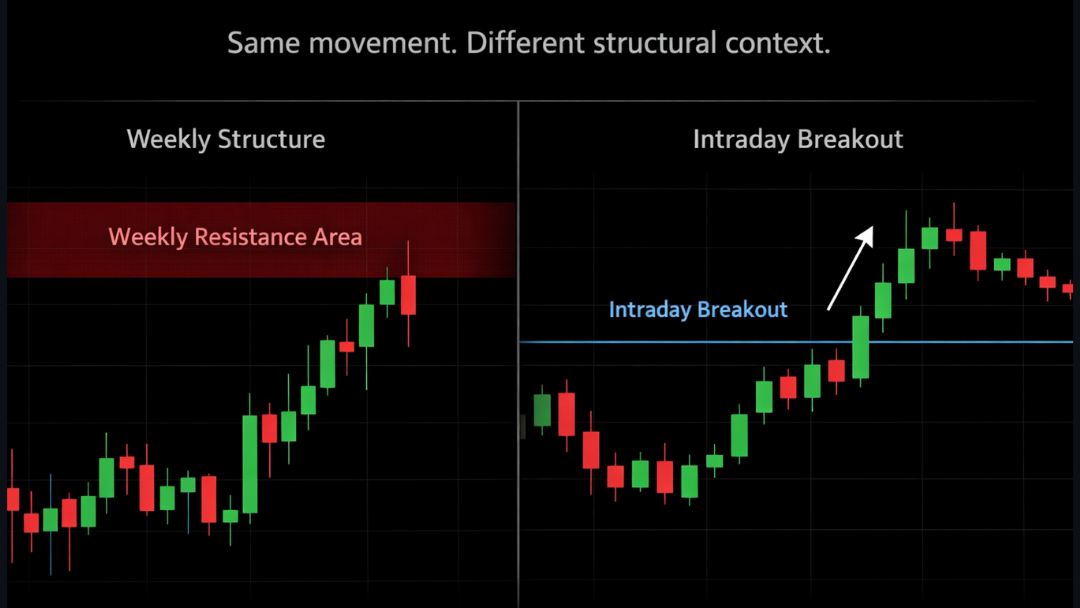
Comparison between weekly structure and intraday breakout.
3. What structural misalignment really means
Structural misalignment is not a judgment. It is a difference in hierarchy.
When intraday structure develops against a relevant weekly area:
- structural friction increases
- continuation depends on breaking the higher structure as well
- instability becomes more likely
Conversely, when intraday dynamics align with the weekly structure, context tends to be more coherent.
The difference is not about prediction. It is about context quality.
4. Common mistakes when higher timeframe context is ignored
Without a higher structural reference, it becomes more frequent to:
- overestimate local breakouts
- interpret short accelerations as primary trend shifts
- change bias multiple times during the same session
- assign excessive importance to minor levels
These mistakes do not originate from the level itself. They originate from the absence of hierarchy.
5. What “Reference Weekly vs Current” technically represents
The Reference Weekly vs Current framework makes the comparison between two structural elements explicit:
- Weekly Reference → the structural candle built from the previous days of the week
- Current → the live candle of the ongoing session, updated in real time
This comparison immediately highlights the position of the current session relative to the broader weekly structure.
The system automatically classifies the relationship between Current and Weekly Reference as:
- Expansion
- Contraction
A neutral phase refers to a condition in which price moves within the weekly range without testing significant structural areas. In this case, intraday dynamics may develop without major friction, but without the support of a higher directional structure.
Below the chart, a numerical reference value is displayed, providing an objective technical anchor.
This is not a trading signal. It is a structural comparison.
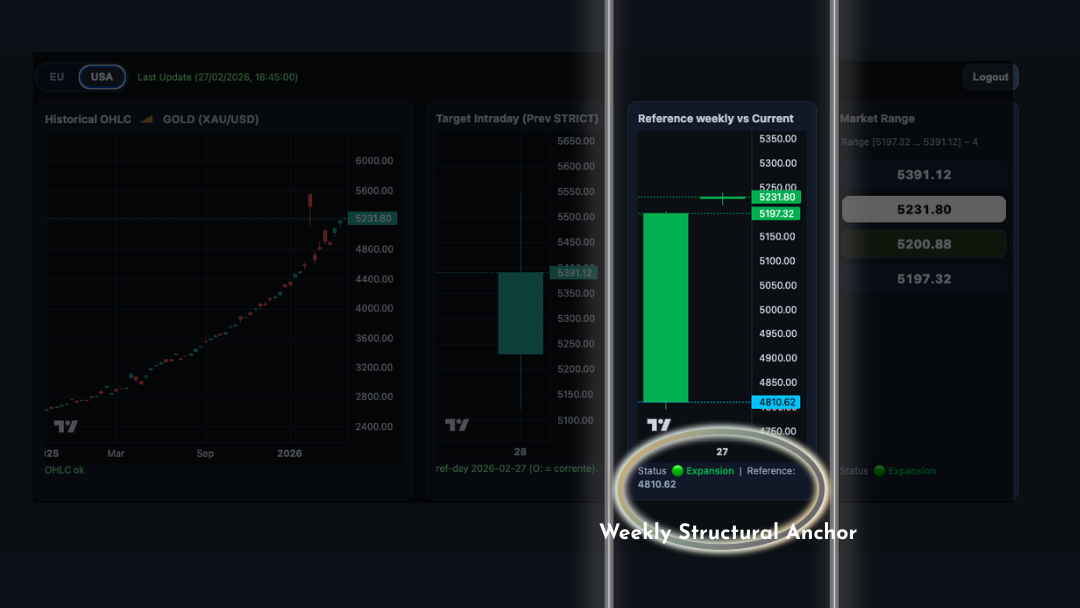
Reference Weekly vs Current panel with structural session classification.
6. Higher timeframe structure does not eliminate intraday opportunities
Integrating the weekly timeframe does not eliminate intraday trading.
It refines the quality of context in which intraday movements are evaluated.
A move against higher structure can still exist. It simply requires a more attentive reading of hierarchy.
Higher timeframe structure does not restrict analysis. It adds depth to it.
7. Conclusion: depth before speed
Intraday trading does not operate in isolation.
Every extension or compression develops within a broader structure.
The Reference Weekly vs Current comparison does not increase analytical speed.
It increases contextual depth.
Understanding where the current session stands relative to the weekly structure reduces interpretative fragility.
In intraday trading, context quality always precedes decision quality.
Explore the framework
If you want to observe how weekly structure integrates with Market Status, levels, and range within a structured environment, you can explore how The Method Pro implements this comparison.
👉 Discover how the framework works and try it free for 5 days.
Note: The Method Pro is an analysis and market-reading support software. It does not provide financial advice or trading instructions; all decisions remain the sole responsibility of the user.