

A practical guide to integrating intraday analysis software into the decision-making process, while maintaining control, method, and responsibility.
1. Understanding a tool is not the same as knowing how to use it
Those searching for how to use an intraday analysis software are not looking for shortcuts.
They are looking for a correct way to integrate structured information into their decision-making process, without losing control or consistency.
Many intraday analysis tools are used with incorrect expectations:
informational support is often confused with operational decision-making.
This article aims to clarify how to use an intraday analysis software correctly, avoiding common misunderstandings and improper use that can lead to inconsistent market readings.
2. The tool does not make operational decisions (and should not)
An intraday analysis software does not make operational decisions on behalf of the trader.
And it should not.
Its role is to:
- organize market data
- make intraday structure readable
- provide coherent and updated reference points
It is not:
- an execution system
- an automatic decision-maker
- a substitute for the trader
Using an analysis tool correctly means keeping two levels clearly separated:
- market reading
- operational decision-making
The software contributes to the decision-making process, but it does not determine it.
3. How to read intraday levels without turning them into instructions
One of the most searched topics concerns intraday levels and how to use them in practice.
The issue is not what levels are, but how they are read and, more importantly, how they are misinterpreted.
Problems arise when a reference point is treated as an instruction rather than as part of a structured reading framework.
In these cases:
- context is lost
- confirmation is sought instead of coherence
- a reactive mindset takes over
A correct reading of intraday levels is contextual, not automatic.
The value of a reference lies in the quality of interpretation, not in immediate reaction.
4. The role of context during the intraday session
In intraday trading, the same data point can take on different meanings throughout the session.
Context helps to:
- frame the market phase
- maintain coherence in interpretation
- avoid isolated readings
Concepts such as Market Status in intraday trading help place information within a structured framework, without suggesting operational actions.
Context does not tell you what to do.
It clarifies where you are.
5. Integrating an analysis software into the intraday routine
Correct use of an intraday analysis software is not occasional or episodic.
A structured approach involves:
- before: reviewing reference levels and context
- during: observing price movements coherently
- after: reviewing the quality of the reading, not the outcome
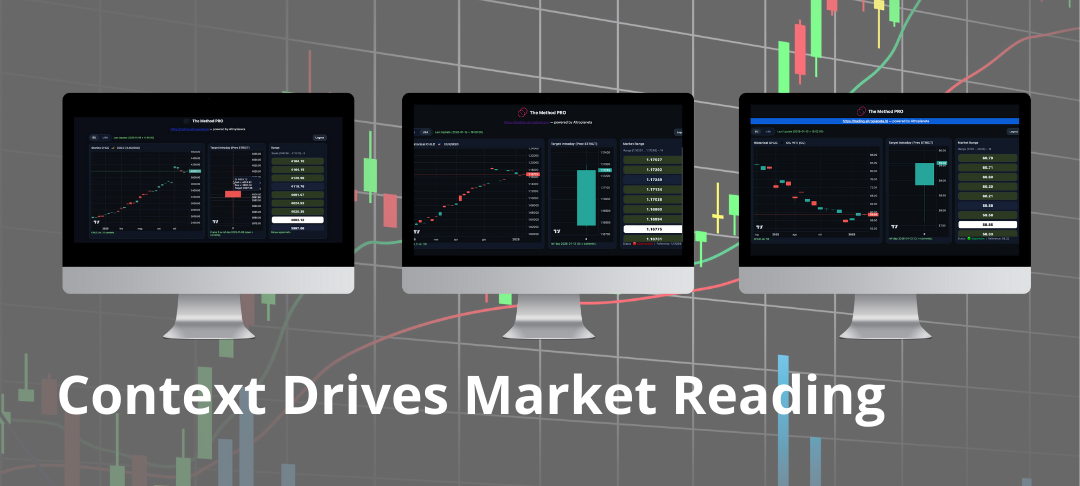
Intraday analysis tools such as The Method Pro are designed to support this process, providing automated, data-driven operational references without replacing strategy, timing, or risk management.
6. Common mistakes when using intraday analysis software
Many errors do not stem from the tool itself, but from how it is used:
- seeking confirmation instead of reference points
- consulting the software only under stress
- changing interpretation with every price fluctuation
- implicitly delegating decisions to the tool
Recognizing these mistakes is an essential part of correct and conscious usage.
7. Correct use equals applied method
Using an intraday analysis software correctly means applying a method, not delegating decisions.
The tool organizes data.
Context clarifies interpretation.
The decision remains the trader’s responsibility.
This article represents the transition between understanding the method and applying it to specific market contexts.
For an asset-specific perspective, see also:
Gold intraday: operational context and interpretation of reference levels (XAU/USD).
For questions about usage, limits, and system scope, refer to the FAQ section.
Note: The Method Pro is a market analysis and market-reading support software. It does not provide financial advice or trading instructions; all decisions remain the user’s responsibility.