


What Market Status means in intraday trading and how to interpret Expansion and Contraction phases to read market context
1. Why Market Status comes before action
In intraday trading, one of the most common sources of error is acting before understanding the current state of the market.
This is where Market Status in intraday trading becomes relevant: as a structured informational reference for contextual reading, not as an operational tool.
Market Status does not suggest what to do.
It describes the phase in which the market currently is, providing context before any operational evaluation takes place.
2. What Market Status means in intraday trading
Market Status is an automated classification of the market state during the intraday session, based on observed market structure.
Its purpose is not to predict outcomes or generate trading instructions, but to describe the current market phase.
Its purpose is to distinguish different market phases, helping traders interpret intraday behavior with context.
In simple terms, Market Status answers the question:
“What type of market phase are we observing right now?”
3. Expansion and Contraction: what they really indicate
Within intraday Market Status, two conditions are commonly observed: Expansion and Contraction.
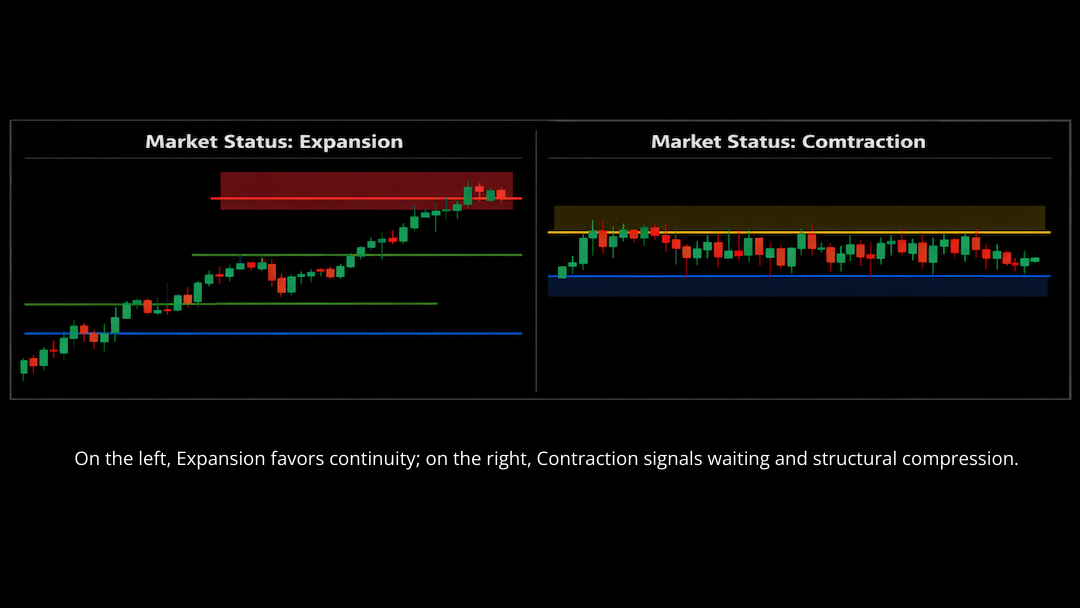
- Expansion describes a phase where market movement tends to widen, showing increased range and continuity.
- Contraction describes a phase of compression, pause, or reduced movement intensity.
It is essential to clarify what these states are not:
- they are not forecasts
- they are not trading signals, but informational context indicators
- they are not trading instructions
Expansion and Contraction describe how the market is behaving, not what actions should be taken.
Visual comparison between Market Status Expansion and Contraction in the intraday context.
4. Why the same level changes meaning depending on Market Status
A price level observed without context is always incomplete information.
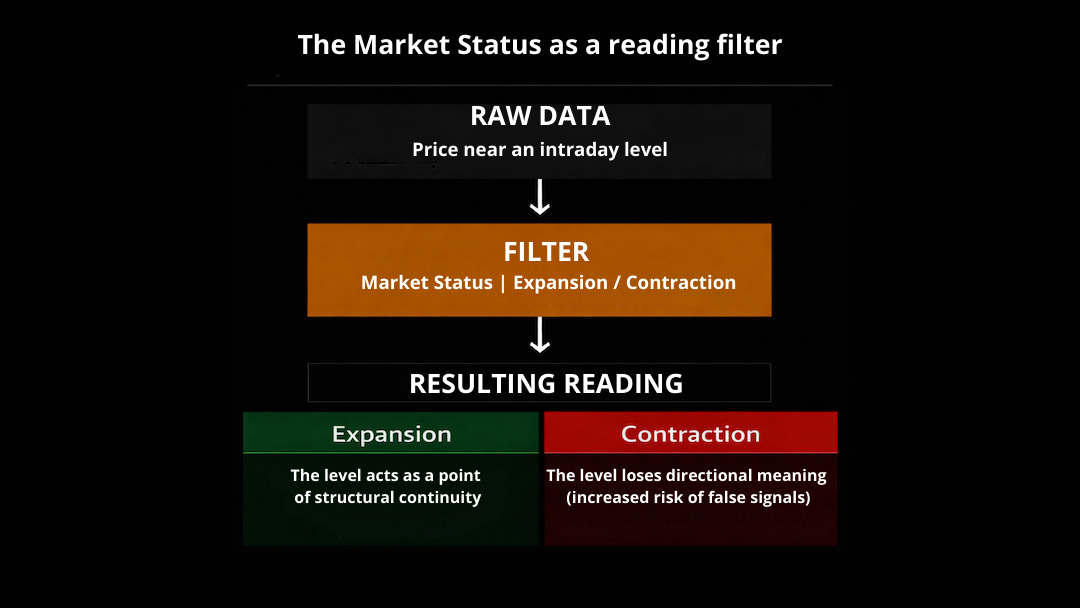
Market Status influences how levels are interpreted:
- the same level can carry different meaning in different phases
- context always comes before reaction
- contextual reading precedes any operational evaluation
Market Status does not change the level itself, but changes the way that level is read during the intraday session.
Market Status as a context-reading filter before any operational evaluation.
5. Market Status as a tool for intraday consistency
One of the main values of Market Status is consistency in market reading.
When used correctly, it:
- helps maintain a stable interpretive framework
- reduces frequent shifts in approach during the session
- prevents contradictory readings driven by isolated movements
Market Status does not accelerate the decision-making process; it stabilizes the consistency of market reading.
6. Common mistakes when reading Market Status
Misunderstandings often arise from improper use of the Market Status concept:
- treating it as a hidden operational signal rather than an informational reference
- trying to anticipate state changes instead of observing them
- ignoring intraday time context
- forcing operational conclusions
These errors occur when Market Status is used to decide, rather than to read.
7. Market Status as part of a structured framework
Market Status is a key for reading intraday market conditions.
Analysis tools such as The Method Pro integrate this logic within a structured framework, making a coherent, automated, and continuous market-state reading available, while keeping analysis and decision-making clearly separated.
The principle remains unchanged: the tool supports reading, it does not decide.
8. Conclusion: Market Status doesn’t tell you what to do, it tells you where you are
Ultimately, Market Status in intraday trading is not a compass pointing toward profit, but a map defining the terrain you are navigating. Correctly identifying Expansion and Contraction phases means shifting from chasing prices to understanding the session's structure. Knowing where the market is located is the only way to give meaningful context to the levels you observe.
Apply Context Reading with The Method Pro
Note: The Method Pro is a market analysis and market-reading support software. It does not provide financial advice or trading instructions; all decisions remain the user’s responsibility.